

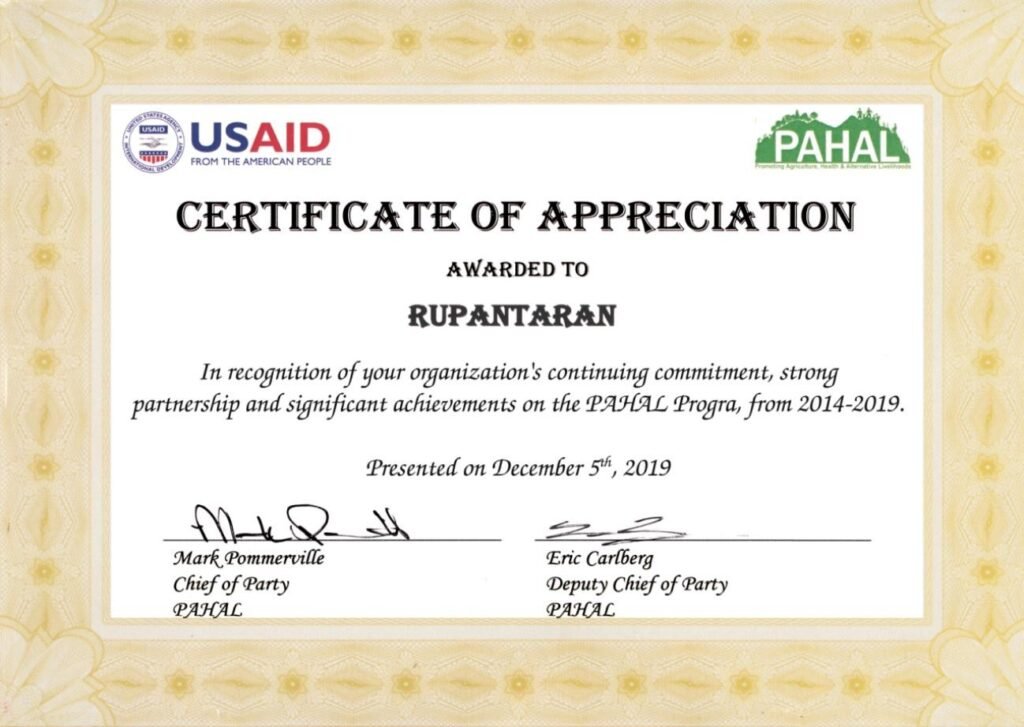
The Promoting Agriculture, Health and Alternative Livelihoods (PAHAL) program was a landmark $37 million, five-year multi-dimensional project funded by the United States Agency for International Development (USAID) to achieve sustainable food security and community resilience among vulnerable populations in Nepal. Implemented through a strategic consortium led by iDE Nepal, Rupantaran served as a core national consortium partner, directly spearheading the Natural Resource Management (NRM) and environmental sector interventions. Operating across 14 highly climate-stressed districts spanning the Far-Western (Achham, Bajhang, Bajura, Baitadi, Dadeldhura, Darchula, and Doti) and Mid-Western regions (Dailekh, Surkhet, Jajarkot, Pyuthan, Rolpa, Rukum, and Salyan), Rupantaran applied a systems-based, multi-sectoral approach to address underlying socio-political, economic, and ecological constraints driving food insecurity.
- Sustainable Forest Management and Institutional Capacity Building
Strategic Overview
Rupantaran introduced systemic governance and data-driven ecological planning within community forest management frameworks to replace ad-hoc resource utilization. By establishing institutional baselines and delivering professional technical mentoring, the organization capacitated grassroots actors to scientifically measure, preserve, and sustainably harvest forest assets, ensuring long-term ecological balance and community-led conservation.
Impactful Achievements and Outcomes
- Conducted comprehensive institutional capacity building for Agriculture, Forest, and Environment Committees (AFECs) on local governance and planning.
- Provided long-term, structured coaching to Community Forest User Groups (CFUGs) on the core principles of Sustainable Forest Management (SFM).
- Trained CFUGs on the practical benefits of sustainable forest management, embedding conservation principles into localized environmental modules.
- Executed extensive technical health checks on localized forest management practices to align field activities with national conservation guidelines.
- Climate Resilience, Disaster Preparedness, and Water Protection
Strategic Overview
To safeguard remote community ecosystems from erratic climate variability and physical landscape vulnerabilities, Rupantaran deployed localized disaster mitigation models. The intervention prioritized training local groups to understand geographical hazards, formulate rapid-response protocols, and secure endangered water catchments through community-administered protection designs.
Impactful Achievements and Outcomes
- Organized specialized risk and hazard orientation events for CFUGs, Water User Groups (WUGs), Department of Soil Conservation and Watershed Management (DSCO) groups, and Farmer Groups.
- Delivered technical, hands-on training to community forest groups on forest fire prevention, mitigation, and rapid-response management.
- Facilitated the technical engineering and strategic preparation of comprehensive, community-owned Water Source Protection Plans.
- Evaluated climate change and disaster risk reduction adaptive actions of CFUGs through integrated climate-smart health checks.
- Market-Led Livelihoods and Supply Chain Development
Strategic Overview
Rupantaran linked ecological conservation directly with financial viability by developing localized, market-driven supply chains. By incubating private local entrepreneurs and creating permanent green infrastructure, the organization established a self-sustaining eco-commerce loop where community members gained direct access to essential inputs, premium tools, and resource markets.
Impactful Achievements and Outcomes
- Identified, oriented, and mobilized appropriate private service providers capable of supplying agricultural tools and technical knowledge for forest, water, and land management.
- Developed local agrovets and hardware traders as certified private service providers to establish a robust, reliable supply chain of inputs for Sustainable Forest Management.
- Established community-level Multipurpose Nurseries to act as decentralized hubs for eco-friendly bioengineering plants and climate-resilient flora.
- Streamlined the flow of micro-investments into pro-poor, forest-based livelihoods and sustainable green enterprises.
- Inclusive Governance, Social Accountability, and GESI Integration
Strategic Overview
Rooted in rights-based advocacy, Rupantaran reformed community-level institutional planning by embedding Gender Equality and Social Inclusion (GESI) and strict transparency principles into local resource governance. The organization established transparent accountability loops and created safety nets for historically marginalized households by directly integrating community micro-plans into macro-level government planning workflows.
Impactful Achievements and Outcomes
- Integrated GESI perspectives directly into the revision of CFUG Operational Plans, Sustainable Use Plans, and Community-Based Adaptation Plans (CBAPs).
- Supported the harmonization of local plans by compiling CFUG annual plans and aligning them with Local Disaster Risk Management Plans (LDRMPs).
- Facilitated the mainstreaming of community annual plans into the formal Village Development Committee (VDC) planning process via Ward Citizen Forums (WCF) and AFECs.
- Spearheaded a landmark forest land allocation process, facilitating community assemblies to grant landless, poor, and very poor households direct access to barren forest plots for income-generating activities.
- Institutionalized social accountability metrics by helping CFUGs conduct transparent social and public audits during Annual General Meetings (AGMs).
Strategic Relevance and Institutional Value
Through the PAHAL program, Rupantaran demonstrated master-level capability in managing extensive, multi-million-dollar sub-portfolios under direct USAID compliance standards. The organization’s successful implementation across 14 distinct districts solidifies its institutional capacity to operate at scale within highly complex, logistically challenging geographical terrains. By successfully uniting complex environmental governance, market-led supply chains, GESI-responsive land reform, and multi-tier local government integration, Rupantaran has created a premier blueprint for community resilience. The organization stands uniquely positioned as a highly capable national partner for future large-scale international portfolios in climate change adaptation, inclusive natural resource governance, and integrated landscape-level resilience programming.


0 Comments