
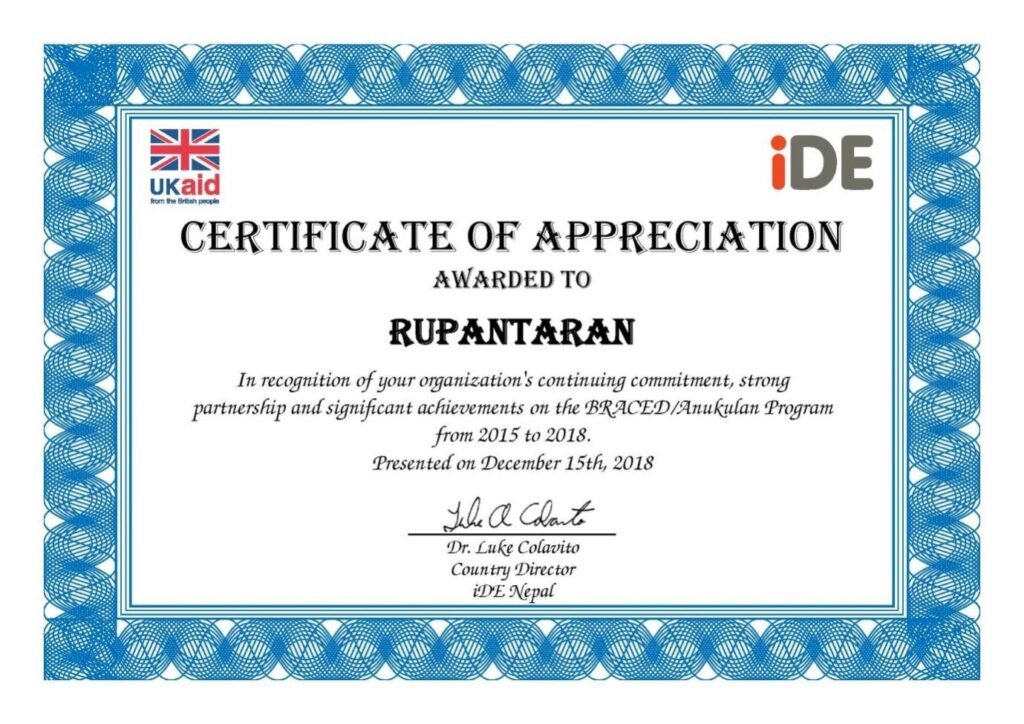
The Building Resilience and Adaptation to Climate Extremes and Disasters (BRACED) programme, funded by the UK’s Department for International Development (DFID), was a multi-country initiative executed across 13 nations in Asia and Africa. In Nepal, the project was localized as the Anukulan program and implemented through an international consortium led by International Development Enterprises (iDE). Rupantaran served as a key national consortium partner, taking on a vital dual mandate: providing overall managerial leadership for Kailali and Kanchanpur districts while providing comprehensive technical backstopping in climate change adaptation (CCA) across all six project districts, including Doti, Dadeldhura, Bardiya, and Surkhet.
- Local Adaptation Planning and Climate Action Institutionalization
Rupanataran operationalized decentralized climate governance by aligning community-level adaptation requirements with municipal planning frameworks under the national Local Adaptation Plan for Action (LAPA) guidelines. By providing technical backstopping and generating targeted evidence, the organization empowered local government bodies to effectively absorb climate metrics and deploy dedicated adaptation funds to vulnerable rural structures.
Impactful Achievements and Outcomes
- Facilitated the formulation, synchronization, and DRR-harmonization of 51 Local Adaptation Plans for Action (LAPAs) and 57 Community Adaptation Plans of Action (CAPs) across all working districts.
- Led the critical revision and technical adaptation update of 12 existing LAPA planning documents.
- Unlocked and integrated Climate Change Adaptation (CCA) initiative funds for a Village Development Committee (VDC) and a rural municipality in Kanchanpur district.
- Supported Middlesex University in conducting localized research and spatial studies regarding the systematic integration of local adaptation plans and disaster risk management plans.
- Documented grassroots field lessons to publish the comprehensive ‘Catalogue of CCA Approaches and Technologies’ as a blueprint for replication.
- Deploying Clean Energy and Climate-Resilient Technologies
To address severe water security stresses, minimize indoor air pollution, and curb household biomass dependency, Rupantaran accelerated the sealing of community-managed clean energy and water infrastructure. The strategy coupled the deployment of technical physical assets with community-administered revolving financial mechanisms to assure operational sustainability.
Impacful Achievements and Outcomes
- Coordinated and technically supported the installation and deployment of 65 domestic biogas plants in collaboration with district energy environment sections.
- Facilitated the procurement and zero-subsidy installation of 142 Improved Cooking Stoves (ICS) across project working areas (Kailali: 16, Kanchanpur: 1, Bardiya: 79, Surkhet: 46), successfully saving approximately 50% in fuelwood consumption.
- Contributed to verified carbon offsets, reducing indoor air pollution by 30% to 90% and mitigating approximately 355 tCO2e per year via fuel-efficient stoves and 493.96 tCO2e per year via biogas channels.
- Constructed and operationalized a Solar Multiple Water Use System (MUS) in Dhapreni, Kailali district, in coordination with the Alternative Energy Promotion Centre (AEPC).
- Established and maintained a localized water recharge pond optimized for fishery-based income generation and adjacent ditch vegetable farming.
- Provided rigorous technical operation support to 52 legacy community-managed Distillation Unit (DU) plants while engineering 2 new DU setups.
- Operationalized 4 sustainable DU revolving funds backed by transparent mobilization and utilization guidelines.
- Commercial Agricultural Training and Essential Oils Livelihood Upgrades
Recognizing that long-term resilience depends on financial insulation, Rupantaran shifted subsistence farming into specialized commercial value chains. By introducing modern field management models and expanding high-value essential oil cultivation, the organization created resilient non-traditional income streams for rural households.
Impactful Achievements and Outcomes
- Delivered technical capacity training on nursery management, Integrated Pest Management (IPM), and post-harvest handling to maximize commercial vegetable production.
- Capacitated 217 dedicated agricultural households to adopt high-value essential oil crop farming, introducing commercial Chamomile and Mentha varieties.
- Secured substantial income generation, enabling essential oil group members to earn NRs 3,989,576 in Kanchanpur and NRs 2,005,350 in Kailali through essential oil market linkages.
- Distributed and installed 4,084 water-efficient Micro-Irrigation Technologies (MITs) alongside 19 demonstration Improved Cooking Stoves to model climate-smart household setups.
- Building Local Technical Human Capital and Resource Networks
Rupantaran focused on building local human capital to eliminate structural dependency on external specialists. By building a robust network of community-level service providers, master trainers, and specialized technicians, the organization ensured that vital agricultural, technical, and maintenance services remained accessible within the villages
Impactful Achievements and Outcomes
- Developed and trained a specialized pool of 37 local LAPA/CAP resource persons to spearhead localized climate-adaptive planning.
- Built grassroots technical capacity by training 28 Community-Based Facilitators (CBFs) and 14 local agro-vets.
- Upskilled 62 professional nursery growers, 20 specialized MIT masons (mistris), and 49 dedicated ICS promoters to drive enterprise adoption.
- Established 13 fully functional Community Climate Resource Centres (CCRCs) to serve as local knowledge hubs for climate alert dissemination.
- Business Planning, Market Integration and Local Governance Alignment.
Rupantaran aligned grassroots commercial enterprises with broader macro-level governance bodies to guarantee market access and long-term sustainability. Through business plan development and continuous monitoring committees, the project reinforced transparent governance and collaborative problem-solving across all field sites.
Impactful Achievements and Outcomes
- Facilitated comprehensive business plan development for a Marketing Planning Committee (MPC), introducing cost-benefit and production plans at the farm-group level.
- Supported and mobilized 55 multi-stakeholder coordination committees, 20 Municipal Planning Committees (MPCs), and formed 20 functional MPC market structures.
- Facilitated 5 National Program Advisory Committee (NPAC) meetings and 20 District Program Advisory Committee (DPAC) review sessions across Rupandehi, Kapilvastu, Kaski, Syangja, Dang, and Rolpa.
- Coordinated extensive field-level joint monitoring visits and learning-sharing workshops, culminating in a successful final evaluation by the Social Welfare Council (SWC).
Strategic Relevance and Institutional Value
Through the Anukulan program, Rupantaran demonstrated extraordinary institutional capabilities in managing large-scale, multi-district portfolios under complex international frameworks like the DFID-BRACED fund. The organization proved its capacity to seamlessly blend high-level district-wide managerial coordination with specialized grassroots technical execution. By successfully intertwining climate policy integration, advanced clean energy deployment, specialized essential oil value-chain scaling, and multi-stakeholder governance models, Rupantaran established a resilient, market-led environmental blueprint. This deep operational experience solidifies Rupantaran’s position as a premier national partner uniquely qualified to lead future high-value, climate change adaptation initiatives, Nature-based Solutions (NbS), and inclusive sustainable economic development portfolios across diverse geographical regions.

0 Comments