
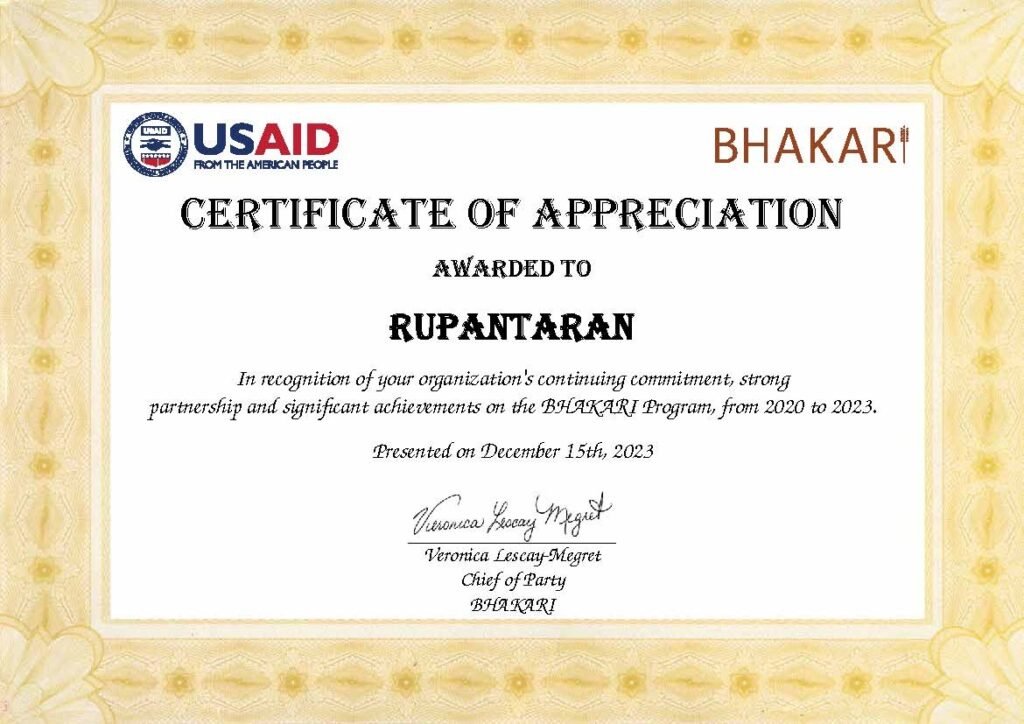
The BHAKARI Program was a high-impact, multi-year initiative funded by the United States Agency for International Development (USAID) to build community resilience against climate shocks and food insecurity in Nepal. Rupantaran served as a national-level consortium partner, taking direct responsibility for technically driving Purpose 1 and Purpose 3 of the program. Operating across 6 highly vulnerable districts—Surkhet, Dailekh, Achham, Kalikot, Jumla, and Mugu—Rupantaran translated complex vulnerability data into inclusive, community-led infrastructure and livelihood systems. Through institutional capacity development, innovative bioengineering, and multi-stakeholder governance, Rupantaran secured immediate risk reduction and built long-term systemic resilience.
- Strengthening Local Disaster Preparedness and Risk Governance
Rupantaran spearheaded the formulation and institutionalization of community-owned disaster action plans across the target landscape. The strategy moved beyond document creation to building active, well-equipped local response mechanisms capable of handling immediate climate risks and operationalizing multi-tier safety frameworks.
Impactful Achievements and Outcomes:
- Conducted Integrated Community Assessments and Action Planning (ICAAP) refreshers across all 6 districts, updating local hazard mitigation plans for 252 communities.
- Strengthened 252 Community Disaster Management Committees (CDMCs) by equipping them with operational Early Warning Tools and real-time information access platforms.
- Maximized immediate localized search and rescue response times by distributing specialized Light Search and Rescue (LSAR) materials to community committees.
- Developed and updated comprehensive Disaster Preparedness and Response Plans (DPRP) for 21 working municipalities, 6 districts, and 1 province to fortify regional risk governance.
- Deploying Innovative Bioengineering and Nature-Based Solutions
To mitigate recurrent landslides, control seasonal flash floods, and protect critical water resources in the Karnali Region, Rupantaran introduced highly effective, eco-friendly bioengineering structures. These nature-based solutions successfully interlocked soil matrices and created physical buffers that shielded vulnerable downstream habitats.
Impactful Achievements and Outcomes:
- Stabilized fragile eco-terrains and reduced landslide vulnerability across 119 climate-vulnerable working communities.
- Pioneered the localized deployment of structural Bamboo Crib-walls, Wattling, Brush Layering, and Fascine techniques to arrest massive soil erosion.
- Established 11 state-of-the-art Multipurpose Nurseries across all 6 districts to act as decentralized environmental hubs.
- Propagated and distributed diverse bioengineering plants, livestock fodder, and high-value Non-Timber Forest Product (NTFP) species to enhance regional climate resilience.
- Advancing Sustainable Forest Governance and GESI-Responsive Land Reform
Recognizing that ecological sustainability is fundamentally linked to social equity, Rupantaran optimized the governance of Community Forest User Groups (CFUGs) to favor landless and marginalized households. The initiative focused on promoting sustainable forest utilization while simultaneously dismantling socio-political access barriers.
Impactful Achievements and Outcomes:
- Empowered local CFUGs through structured institutional self-evaluations and annual plan preparations embedded with Gender Equality and Social Inclusion (GESI) perspectives.
- Facilitated a milestone Land Allocation Initiative that targeted barren community forest lands (crown cover under 20%) for poverty reduction.
- Secured formal land access for landless and land-poor CFUG members to launch sustainable, forest-based income-generating activities.
- Completed 5 landmark land allocations distributed equitably across the region, with exactly one allocation finalized in Mugu, Jumla, Kalikot, Dailekh, and Achham.
- Elevating Climate-Resilient Agriculture and Food Security Systems
Rupantaran executed targeted agricultural interventions designed to enhance household-level food availability, upgrade traditional crop yields, and establish adaptive safety nets for socially excluded populations facing recurrent water scarcity and drought conditions.
Impactful Achievements and Outcomes:
- Conducted specialized small-group technical trainings focused on high-yield Kitchen Garden Production to improve household nutrition compounds.
- Facilitated the distribution of Input Voucher Packages, ensuring vulnerable farmers acquired necessary resources to enhance produce quality and quantity.
- Formulated practical field demonstrations on innovative cultivation methods for selected crops, including vegetables, potatoes, beans, fruits, nuts, and ginger.
- Mainstreamed rapid-response pest alert access for threats like the Fall Armyworm (FAW) through institutional alignments with the Ministry of Agriculture and the Department of Hydrology and Meteorology (DHM).
Strategic Relevance and Institutional Value
Through the BHAKARI program, Rupantaran solidified its standing as a premier national organization capable of executing large-scale, complex resilience models under direct USAID funding parameters. The organization successfully proved that long-term climate resilience is only achievable when communities are empowered as local decision-makers, and environmental action is structurally integrated with livelihoods and public governance. This accumulated experience provides a strong comparative advantage for Rupantaran in delivering future international resilience portfolios, large-scale climate change adaptation programs, and nature-based solutions across Nepal.

0 Comments