
The Initiative for Climate Change Adaptation (ICCA) was a five-year, USAID-funded climate change adaptation program implemented in Nepal through a consortium led by iDE Nepal, with Rupantaran and RIMS-Nepal as consortium partners. The program was designed to strengthen the resilience of poor and climate-vulnerable communities by enhancing their capacity to understand climate risks, plan and implement locally appropriate adaptation measures, strengthen climate-resilient livelihoods, and improve access to technologies, services, and institutions that reduce vulnerability to climate change.
ICCA was implemented across eight districts of Nepal—Kaski, Syangja, Kapilvastu, Rupandehi, Dang, Rolpa, Parbat and Nawalparasi—through a combination of intensive and light implementation approaches and in collaboration with local NGO partners. Rupantaran played a significant technical, facilitation and institutional strengthening role within the consortium, supporting communities, local institutions, government stakeholders and local service providers to translate climate vulnerability assessments and adaptation priorities into practical and sustainable interventions.
Rupantaran’s experience under ICCA demonstrates its capacity to work across the full spectrum of community-based climate adaptation—from participatory vulnerability assessment and local adaptation planning to technology demonstration, capacity development, livelihood strengthening, institutional coordination, knowledge management and learning. The organization’s contribution generated a substantial portfolio of community-level adaptation interventions and strengthened local systems for sustaining climate resilience beyond the project period.
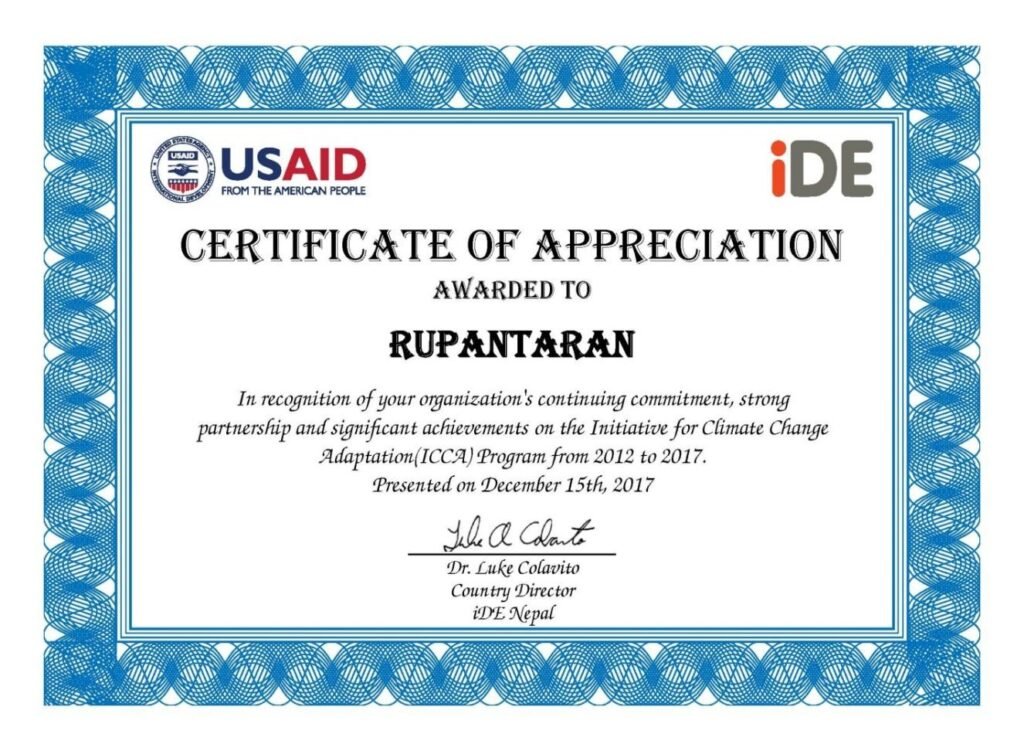
1. Strengthening Local Adaptation Planning and Locally Led Climate Action
A major component of Rupantaran’s work under ICCA was strengthening the capacity of communities and local institutions to identify climate risks and develop locally owned adaptation responses. Following the national Local Adaptation Plan of Action (LAPA) framework, Rupantaran supported the preparation of 51 LAPAs and 57 Community Adaptation Plans of Action (CAPs), and supported the revision of 12 LAPAs.
The planning process was designed to move beyond the preparation of documents and promote meaningful participation of vulnerable households, community institutions and local stakeholders in identifying climate risks, prioritizing adaptation needs and selecting feasible interventions. Rupantaran facilitated the translation of community-identified vulnerabilities into practical adaptation investments, thereby strengthening local ownership and accountability.
The organization also documented field experiences through case studies and contributed to the development of the “Catalogue of CCA Approaches and Technologies.” These knowledge products helped capture lessons, innovations, and locally appropriate approaches that could be replicated and scaled in other climate-vulnerable communities.
Through this work, Rupantaran gained extensive experience in participatory adaptation planning, climate vulnerability assessment, community prioritization, local institutional engagement and integration of adaptation priorities into local development processes.
2. Delivering Practical and Locally Appropriate Climate Adaptation Solutions
Rupantaran supported communities to move from adaptation planning to concrete implementation. The organization facilitated the introduction, demonstration and scaling of a wide range of climate-resilient technologies and practices responding to locally identified risks related to water scarcity, energy access, agricultural productivity, household vulnerability and environmental degradation.
Key achievements included the installation of 307 solar panels, establishment of 13 Community Climate Resource Centres (CCRSCs), installation of 16 Multiple Use Water Systems (MUS) and implementation of 4,084 water-efficient MITs.
These interventions were particularly important because they addressed multiple dimensions of climate vulnerability simultaneously. Improved water systems contributed to household and productive water security; solar energy reduced dependence on conventional energy sources and improved access to clean energy; community resource centres strengthened access to climate information and local knowledge; and water-efficient technologies helped communities respond to increasing water stress and variability.
Rupantaran’s approach emphasized appropriate technology selection, community participation, local ownership, technical capacity and sustainability, rather than treating adaptation interventions as stand-alone infrastructure investments.
3. Building Local Technical Capacity and Strengthening Community Institutions
Rupantaran recognized that sustainable climate adaptation requires strong local institutions and capable community-level service providers. Accordingly, substantial effort was invested in developing a pool of local technical human resources who could continue providing services after project completion.
Rupantaran provided technical support and capacity development to 37 LAPA/CAP resource persons, 28 Community-Based Facilitators (CBFs), 14 agro-vets, 62 nursery growers, 20 MIT masons, and 49 Improved Cookstove (ICS) promoters.
This capacity-building approach strengthened local knowledge and reduced dependence on external technical assistance. Trained resource persons and service providers were positioned to support communities in planning, technology adoption, operation and maintenance, agricultural services, and climate-resilient practices.
The experience demonstrates Rupantaran’s institutional strength in training-of-trainers, development of local resource persons, technical mentoring, community facilitation and institutional sustainability—key competencies for locally led adaptation programming.
4. Demonstrating, Validating and Scaling Climate-Smart Innovations
Rupantaran supported communities to test and demonstrate 30 climate adaptation technologies, innovations and practices designed to improve resilience to climate-related stresses. The interventions were selected and promoted based on local needs, feasibility, affordability, and potential for replication.
Among the key interventions were the installation and scaling-up of 13 distillation units, 84 biogas units and Integrated Pest Management (IPM) demonstrations involving 46 community groups.
The demonstration approach allowed communities to observe the benefits and practical application of new technologies before wider adoption. It also created opportunities for peer learning and adaptation of technologies to local conditions.
This experience has strengthened Rupantaran’s capacity to support the identification, piloting, demonstration, validation, adaptation and scaling of climate-smart technologies and community innovations.
5. Integrating Climate Adaptation with Livelihood Resilience
Rupantaran’s ICCA experience recognized that vulnerable communities cannot achieve long-term climate resilience without strengthening their economic and livelihood security. Therefore, the organization linked adaptation interventions with livelihood opportunities and enterprise development.
Rupantaran facilitated community groups in preparing business plans and production plans, including assessment of costs, benefits, production potential and economic feasibility. The process enabled community groups to better understand investment requirements, expected returns and opportunities for strengthening income-generating activities.
This approach helped shift adaptation from being viewed solely as an environmental or infrastructure issue toward a broader resilience and livelihood development agenda. It strengthened community capacity to make informed economic decisions while incorporating climate risks into production and enterprise planning.
The experience provides Rupantaran with a strong foundation for designing integrated programs that connect climate resilience, livelihoods, entrepreneurship, natural resource management and inclusive economic development.
6. Strengthening Multi-Stakeholder Coordination and Local Governance
Climate change adaptation requires coordination across government agencies, local governments, civil society organizations, technical institutions and community organizations. Rupantaran therefore placed strong emphasis on strengthening multi-stakeholder platforms and institutional coordination mechanisms.
Under ICCA, Rupantaran supported 55 multi-stakeholder coordination committees, facilitated 5 National Program Advisory Committee (NPAC) meetings and 20 District Program Advisory Committee (DPAC) meetings across Rupandehi, Kapilvastu, Kaski, Syangja, Dang and Rolpa.
At the local level, Rupantaran supported the formation and strengthening of 20 Municipal Planning Committees (MPCs) and participated in field-level monitoring and coordination visits. These mechanisms created opportunities for stakeholders to jointly review climate risks, implementation progress, technical challenges, and opportunities for scaling successful interventions.
Rupantaran also contributed to regional and national learning-sharing workshops and supported the final evaluation undertaken by the Social Welfare Council (SWC).
This extensive coordination experience demonstrates Rupantaran’s ability to operate effectively at community, municipal, district, provincial and national levels, and to facilitate collaboration between government and non-government stakeholders around shared climate resilience objectives.
7. Knowledge Management, Learning and Replication
An important dimension of Rupantaran’s ICCA experience was the systematic documentation and sharing of knowledge generated through field implementation. The organization supported case-study development, documentation of adaptation practices and dissemination of lessons through learning-sharing mechanisms.
The publication of the Catalogue of CCA Approaches and Technologies provided a platform for capturing practical adaptation experiences and making them accessible for wider learning and replication.
Rupantaran’s approach to knowledge management emphasized the principle of “learning by doing”, whereby community experiences, technology demonstrations and implementation lessons were documented, reviewed and used to improve subsequent interventions.
This experience has strengthened the organization’s capacity in evidence generation, documentation, learning, knowledge dissemination and adaptive program management.
8. Promoting Sustainability and Local Ownership
A central strength of Rupantaran’s ICCA engagement was its focus on sustainability beyond the life of the project. Rather than relying exclusively on project-funded inputs, Rupantaran invested in local human resources, community institutions, technical service providers, and coordination mechanisms.
The development of local LAPA/CAP resource persons, CBFs, agro-vets, nursery growers, MIT masons and ICS promoters created a network of community-level actors capable of continuing adaptation-related services. Similarly, strengthening community resource centres, planning committees and multi-stakeholder platforms contributed to the institutionalization of climate adaptation at the local level.
This approach reinforced the principle that sustainable adaptation is most effective when communities and local institutions are empowered to lead, manage and maintain adaptation actions themselves.
9. Scale and Diversity of Rupantaran’s Climate Adaptation Portfolio
The breadth of Rupantaran’s ICCA engagement is demonstrated by the scale and diversity of its interventions. The organization contributed to:
• 51 Local Adaptation Plans of Action (LAPAs)
• 57 Community Adaptation Plans of Action (CAPs)
• 12 revised LAPAs
• 307 solar panels
• 13 Community Climate Resource Centres
• 16 Multiple Use Water Systems
• 4,084 water-efficient MITs
• 30 climate adaptation technologies, innovations and practices
• 13 distillation units
• 84 biogas units
• 46 groups reached through IPM demonstrations
• 37 LAPA/CAP resource persons trained
• 28 Community-Based Facilitators trained
• 14 agro-vets trained
• 62 nursery growers trained
• 20 MIT masons trained
• 49 ICS promoters trained
• 55 multi-stakeholder coordination committees supported
• 5 NPAC meetings facilitated
• 20 DPAC meetings supported
• 20 Municipal Planning Committees formed/strengthened
This portfolio demonstrates Rupantaran’s ability to manage and technically support multi-sectoral, multi-stakeholder and geographically diverse climate adaptation interventions at scale.
10. Strategic Relevance to Climate Adaptation and Resilience Programming
Rupantaran’s ICCA experience has established a strong institutional foundation for implementing contemporary climate adaptation approaches, including locally led adaptation, community-based adaptation, climate-resilient livelihoods, Nature-based Solutions (NbS), ecosystem-based approaches, climate-smart agriculture, water security, clean energy, inclusive adaptation and resilient local governance.
The organization has demonstrated that effective climate adaptation requires more than the delivery of individual technologies. It requires an integrated approach that combines climate risk understanding, participatory planning, local leadership, technical innovation, livelihood resilience, institutional strengthening, stakeholder coordination, knowledge management and mechanisms for sustainability and scale.
Building on the ICCA experience, Rupantaran is well positioned to support climate-vulnerable communities and local institutions in developing and implementing locally owned, evidence-based, inclusive and scalable adaptation solutions. Its extensive field presence, technical expertise, experience with government and community institutions, and demonstrated ability to work through partnerships provide a strong platform for larger climate resilience and adaptation initiatives in Nepal.
Overall Institutional Value
The ICCA program represents a significant milestone in Rupantaran’s institutional experience in climate change adaptation. Through the program, Rupantaran moved beyond conventional community development interventions and strengthened its technical and organizational capacity to address climate vulnerability, resilience, adaptive capacity, and locally led climate action.
The experience demonstrates Rupantaran’s capacity to assess vulnerability, facilitate participatory planning, design and implement adaptation interventions, build local capacity, promote climate-smart technologies, strengthen resilient livelihoods, coordinate multi-stakeholder platforms, generate and disseminate knowledge, and support institutional mechanisms for long-term sustainability.
Most importantly, ICCA strengthened Rupantaran’s practical understanding that climate resilience is achieved when communities are empowered as decision-makers, local institutions are strengthened as adaptation actors, technologies are adapted to local realities, and climate action is integrated with livelihoods, natural resources and local development planning. This accumulated experience provides a strong comparative advantage for Rupantaran in delivering future climate change adaptation, resilience, Nature-based Solutions and locally led adaptation programs in Nepal.

0 Comments