

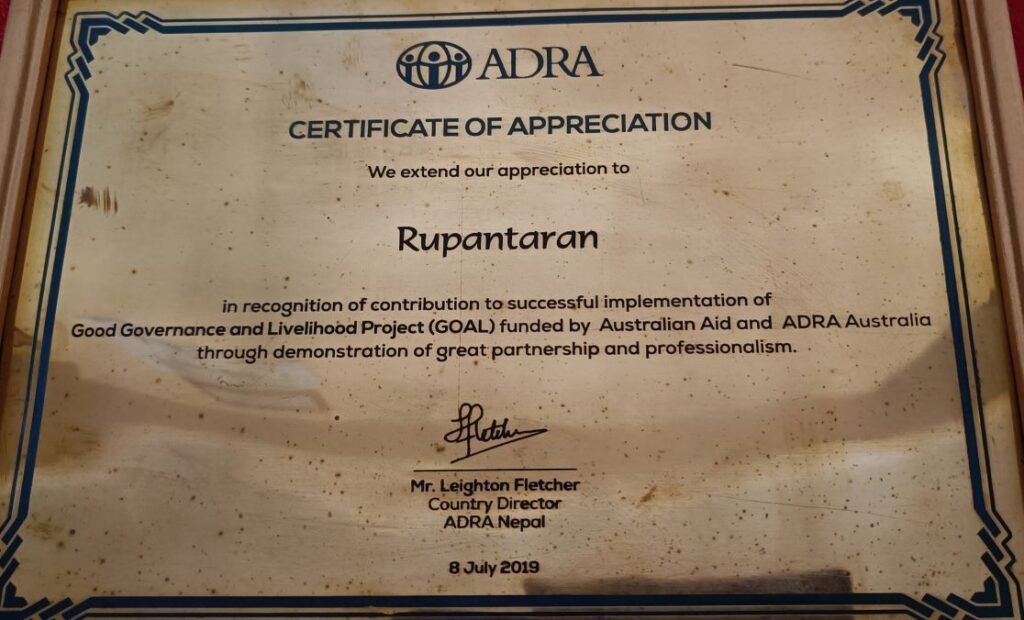
The Good Governance and Livelihood Project (GOAL-I) was a premier climate change adaptation and economic empowerment program funded by Australian Aid and ADRA Australia. Implemented in close strategic partnership with ADRA Nepal, Rupantaran served as a key national implementing partner responsible for translating resilience objectives into sustainable community-driven actions. The program was specifically designed to enhance the resilience capacity of highly vulnerable community groups against the compounding negative impacts of climate change across 12 Village Development Committees (VDCs) in the Rolpa and Pyuthan districts. By blending robust structural planning with inclusive community governance and market-led enterprise systems, Rupantaran created a scalable model for climate adaptation and grassroots livelihood transformation.
- Micro-Enterprise and Entrepreneurship Development
Rupantaran spearheaded specialized enterprise development tracks to shift climate-vulnerable rural communities from high-risk subsistence practices into reliable, resilient micro-economy loops. By introducing formal financial literacy training, standardized entrepreneurial coursework, and strict institutional performance trackers, the organization incubated an agile network of local small-scale business operators capable of maintaining diverse income streams even during periods of climate-induced stress.
Impactful Achievements and Outcomes
- Mobilized and technically capacitated 1,854 community members through 6-month intensive entrepreneurial classroom modules.
- Delivered Start and Improve Your Business (SIYB) training packages to 1,630 targeted local self-help group members.
- Facilitated targeted Training of Small Entrepreneurs (ToSE) curriculum to strengthen operations for 1,386 localized group members.
- Conducted specialized Training of Green Entrepreneurs (ToGE) courses for 1,190 community members to anchor climate-smart ventures.
- Secured a proven 91% enterprise strengthening and survivability rate among all tracked beneficiaries based on annual monitoring benchmarks.
- Directly incubated, launched, and functionally strengthened 1,378 active small-scale community enterprises.
- Civil Society Organization (CSO) Capacity Enhancement
To establish a self-reliant governance framework independent of continuous external oversight, Rupantarn prioritized the structural institutionalization of local civil society organizations. The intervention focused on deploying targeted vocational lines designed to turn rural groups into specialized providers of technical services, thereby establishing permanent localized knowledge repositories within the target districts.
Impactful Achievements and Outcomes
- Upgraded organizational capacity and vocational expertise for 1,193 formal members across registered local CSOs.
- Trained 426 specialized members in high-yield, climate-adaptive agro-based vocational techniques.
- Capacitated 706 community members with modern livestock-based production management and health-maintenance tools.
- Engineered off-farm livelihood pathways for 61 individuals to fully diversify family income away from climate-exposed agricultural fields.
- Designed, managed, and successfully executed 101 custom Vocational Training (VT) events tailored to regional market absorption lines.
- Climate Planning, Environmental Infrastructure, and Landscape Management
Rupantaran linked grassroots environmental awareness campaigns directly with sub-national statutory planning instruments to enforce climate resilience as a standard local development priority. The organization deployed field-validated adaptation technologies, integrated environmental management matrices into educational infrastructure, and constructed critical landscape features to preserve ecosystem health while protecting local livestock assets from biological stressors.
Impactful Achievements and Outcomes
- Completed formal 6-month environmental awareness and climate change adaptation courses across 12 climate-exposed schools.
- Delivered customized environmental sensitization and climate resilience modules to 12 cooperative management networks.
- Formulated and operationalized 36 highly detailed Community-Based Adaptation Plans (CBAPs) aligned with micro-catchment realities.
- Facilitated the tactical drafting and institutional adoption of 12 official Local Adaptation Plans for Action (LAPAs).
- Structured and deployed 12 community-owned Community-Based Disaster Risk Reduction (CBDRR) mitigation frameworks.
- Successfully executed and delivered 109 localized climate-resilient community-led challenge projects.
- Engineered and constructed 16 automated Dipping Tanks at designated goat pocket sites to eliminate external parasite infestations.
- Verified that 91% of 240 sampled household units actively invested their own capital into climate change adaptation interventions.
Strategic Relevance and Institutional Value
Through its flawless execution of the GOAL-I program, Rupantaran cemented its institutional capability to manage and deliver highly complex, multi-sectoral projects funded by strict international entities like Australian Aid and ADRA Australia. The organization’s proven capacity to operate fluidly across 12 distinct VDCs demonstrates clear logistical mastery over logistically difficult geographical landscapes. By successfully bridging massive technical human capital development (1,854 trainees), complex economic incubation (1,378 active businesses), and systemic governance alignment (36 CBAPs and 12 LAPAs), Rupantaran has verified its standing as a premier national partner. The organization remains exceptionally positioned to lead upcoming multi-million-dollar international tenders targeting market-driven climate adaptation, inclusive grass-roots economic development, and landscape-level resilience programming.
This document is generated for institutional portfolio presentation based on compiled project data records.

0 Comments