
The Support to Federalism (StF) Program was a strategic, forward-looking project funded by the United States Agency for International Development (USAID) and implemented in partnership with Abt Associates. Under this overarching federalism support portfolio, Rupantaran took a leading organizational role in assessing the baseline status of localized environment management practices across various local government tiers in Nepal. Executed between 2021 and 2022, this initiative aimed to align municipal operational realities with the environmental safeguards mandated under the Nepalese Constitution of 2015, the Environment Protection Act of 2019, and the Local Institutional Self-Assessment (LISA) framework guidelines. Rupantaran successfully steered high-level multi-stakeholder diagnostic processes and institutional capacity-building actions to bridge policy compliance gaps and reinforce sustainable, decentralized environment governance.
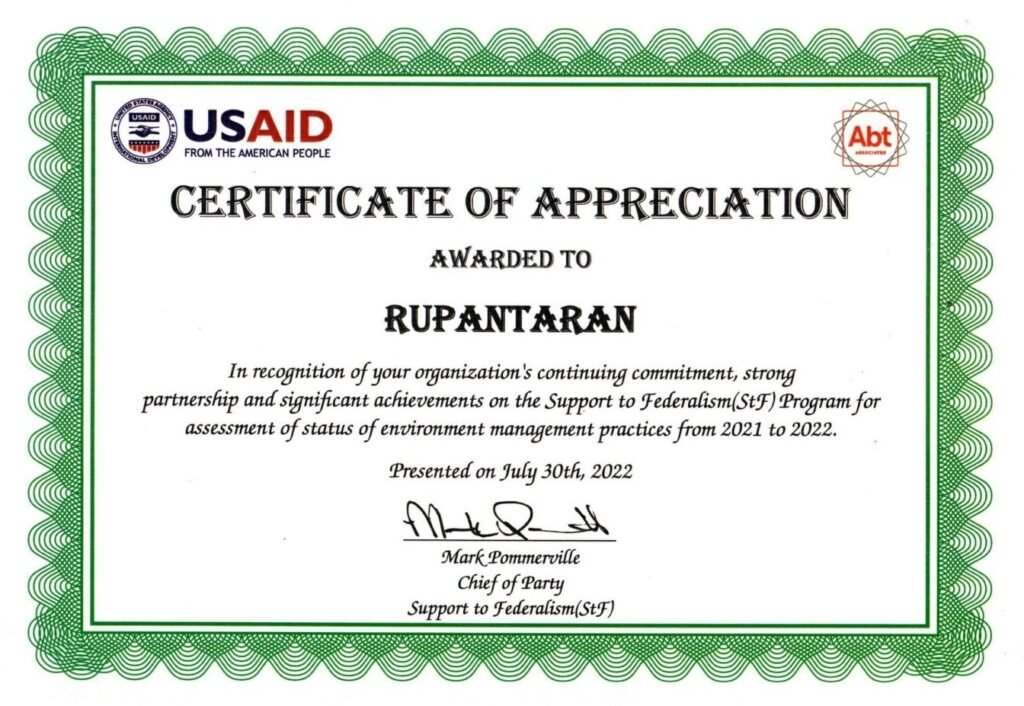
- Diagnostic Assessment of Environmental Management Practices
Rupantaran conceptualized and executed comprehensive, evidence-based environmental diagnostic assessments across multiple local government jurisdictions. Navigating the regulatory complexities introduced by the Environment Protection Regulations (2020) and the Local Government Operational Act (2074), the organization spearheaded intense consultative processes to analyze localized institutional capacities, recognize execution bottlenecks, and evaluate real-time policy operationalization at the municipal level, particularly in the wake of shifting post-COVID municipal priority frameworks.
Impactful Achievements and Outcomes
- Conducted rigorous baseline evaluations of the status of environment management practices across 10 targeted local governmental units.
- Sensitized municipal leaders, elected mayors, and executive administrative staff on the constitutional and statutory provisions under the national Environment Protection Act.
- Facilitated 10 structured Focus Group Discussions (FGDs) to collect bottom-up qualitative perspectives on institutional gaps.
- Executed multi-tiered Key Informant Interviews (KIIs) involving 74 high-level representatives from federal, provincial, and local government bodies.
- Mapped localized resource shortfalls resulting from the diversion of municipal funds toward emergency health responses during the pandemic.
- Municipal Capacity Development and LISA Alignment
Recognizing severe capacity limitations and a widespread inability to clarify institutional responsibilities regarding environmental protection, Rupantaran designed custom, localized technical capacity building modules. The training framework directly integrated the standardized criteria outlined in the Local Institutional Self-Assessment (LISA) guidelines (2021) and the Environmentally Friendly Local Governance (EFLG) framework, empowering local administrations with technical tools to independently execute statutory Initial Environmental Examinations (IEEs) and Environmental Impact Assessments (EIAs).
Impactful Achievements and Outcomes
- Designed and rolled out specialized orientation packages focused on policy formulation and practical implementation challenges.
- Diagnosed critical gaps and administrative constraints regarding environmental compliance within all 10 target local governmental units.
- Conducted rigorous, comprehensive institutional assessments aligned directly with national LISA self-assessment standards.
- Delivered specialized technical training on the operational parameters of the Environmentally Friendly Local Governance (EFLG) framework.
- Empowered elected local leaders and core municipal technical staff with skills to draft custom, localized Environmental Protection Acts.
- Evidence Generation, Policy Dissemination, and Governance Roadmaps
To ensure that diagnostic findings translated into concrete governance adjustments, Rupantaran pioneered rigorous evidence syntheses and strategic dissemination. The organization brought together fragmented horizontal and vertical governance tiers onto a single platform, presenting structured roadmaps that provided municipal governments with clear, actionable transition plans for institutionalizing eco-friendly regulations and legal provisions within their annual planning cycles.
Impactful Achievements and Outcomes
- Synthesized qualitative and quantitative audit data into an actionable, evidence-based policy road-map for decentralized environmental governance.
- Presented diagnostic field findings directly to multi-sector municipal assemblies to foster local institutional ownership.
- Oriented local regulatory bodies on building streamlined, transparent processes for conducting statutory environmental clearances.
- Formulated customized guidelines to assist local units in allocating distinct budget heads for active natural resource conservation.
- Established a peer-learning platform enabling municipal heads to collaborate across jurisdictions on solving cross-boundary ecological hazards.
Strategic Relevance and Institutional Value
Through the successful delivery of the Support to Federalism program’s environmental assessment component, Rupantaran has demonstrated exceptional institutional mastery in regulatory compliance auditing and sub-national governance capacity strengthening. The organization proved its distinctive ability to unpack national legislative mandates—such as LISA, EFLG, and the Environment Protection Act—and translate them into functional municipal systems. By managing multi-tier government dialogues and generating authoritative diagnostic data under USAID and Abt Associates compliance protocols, Rupantaran has fortified its position as a high-caliber national partner. The organization is uniquely equipped to design, lead, and execute future international portfolios centered on decentralized environmental policy, sub-national institutional restructuring, climate governance audits, and localized sustainable resource management models across Nepal.

0 Comments