
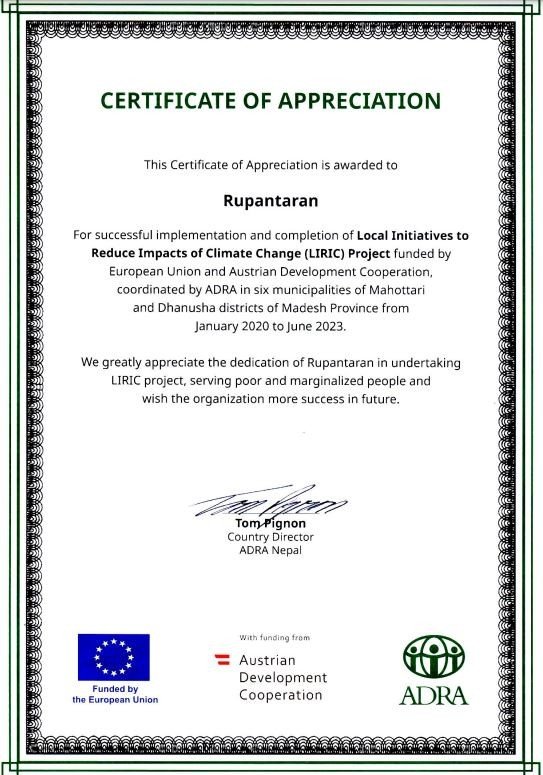
The Local Initiatives to Reduce Impacts of Climate Change (LIRIC) project was a high-impact initiative funded by the European Union and the Austrian Development Cooperation to tackle the escalating risks that climate change imposes on water resources and sustainable agriculture in Nepal. Implemented through a robust consortium coordinated by ADRA Nepal, Rupantaran served as a key national partner, directly driving grassroots community mobilization, capacity-building, and localized technical interventions. Operating inside the vulnerable Madhesh Province within the Mahottari and Dhanusha districts, the project focused its core operations across six target local governments (Bardibas, Bhangaha, Aurahi, Gaushala, Mithila, and Bateshwor) situated along the upstream and downstream corridors of the critical Ratu, Aurahi, and Maraha river systems. Through inclusive civic advocacy, landscape-level rehabilitation, and institutional coordination, Rupantaran transformed local vulnerabilities into sustainable, climate-resilient community structures.
- Technical Support for Climate-Resilient Agricultural Interventions
Strategic Overview
Rupantaran addressed critical landscape degradation and agricultural vulnerability by implementing community-led, commercial ecosystem restoration designs. By transforming marginalized and degraded terrains into high-yield, climate-adaptive assets, the organization enhanced the long-term food security, land productivity, and economic self-reliance of poor and climate-vulnerable communities.
Impactful Achievements and Outcomes
- Facilitated leasehold farming initiatives across two community-level Civil Society Organizations (CSOs) in Bhangaha and Gaushala municipalities, acquiring 169 Kattha of land for climate-smart rice and vegetable cultivation.
- Secured direct livelihood and food production alternatives for 34 vulnerable agricultural beneficiaries through specialized input supply networks.
- Rehabilitated and restored 30 hectares of highly degraded communal lands to arrest soil erosion and restore ecosystem vitality.
- Procured and distributed 3,890 tropical fruit plants (including high-value mango, litchi, lemon, jackfruit, guava, and blackberry) to expand climate-adaptive agroforestry schemes.
- Constructed three multi-purpose conservation ponds optimizing water storage for fish farming, directly benefiting 178 climate-vulnerable households with a stock of 4,000 fingerlings.
- Equipped 86 community-level CSOs with specialized climate-smart agricultural infrastructure materials, including plastic tunnels, mulching sheets, and localized drip irrigation pipes for practical demonstration plots.
- Local Government Capacity Building and Climate Action Institutionalization
Strategic Overview
To transition climate resilience from localized pilots into permanent policy systems, Rupantaran focused heavily on upgrading sub-national risk governance. By developing practical educational programs, mapping municipal risk baselines, and certifying native human capital, the organization institutionalized data-driven adaptation planning within formal local government development tracks.
Impactful Achievements and Outcomes
- Formulated a comprehensive School Level Curriculum on Climate Change Awareness, successfully delivering localized environmental modules to 161 Grade 7 and Grade 9 students (including 53% girls) across six regional schools.
- Capacitated and trained local public-school teachers via dedicated Training of Trainers (ToT) courses to ensure continuous, independent climate change curriculum delivery.
- Formulated and published 24 detailed, localized municipal climate profiles to provide local governments with actionable risk and planning data.
- Conducted rigorous climate vulnerability and capacity assessment training for local government staff, utilizing integrated local and scientific spatial data frameworks.
- Formed, structured, and systematically monitored 87 local CSOs using customized climate-adaptive well-being indices to assess ongoing ground-level vulnerabilities.
- Trained 29 professional stakeholders (including 71% women) consisting of 11 core organizational staff members and 18 CSO network representatives on advanced localized adaptation frameworks.
- Formulated a standardized operational curriculum for local Climate Field Schools (CFS) and built a highly capable pool of certified CFS facilitators.
- Piloting and Mainstreaming Payments for Environmental Services (PES)
Strategic Overview
Rupantaran pioneered sustainable environmental financial systems by designing and executing highly innovative upstream-downstream economic loops. By connecting community resource protection directly with long-term marketplace compensation, the organization established clear, replicable pathways for self-funding resource management and resilient green growth.
Impactful Achievements and Outcomes
- Conducted foundational site identification and completed comprehensive technical scoping studies for multiple potential PES schemes across connected upstream and downstream project catchments.
- Developed strategic operational plans and finalized field execution designs for five potential PES piloting initiatives.
- Institutionalized the landmark Kalapani-Marka drinking water scheme to establish equity-based water supply compensation tracks.
- Launched the Bahunmara irrigation scheme and the Khayermara drinking water scheme to secure community-led financial safety nets for agricultural water grids.
- Designed and implemented the Bhangaha riverbed farming scheme alongside the Mithila Sagar recreational water scheme to bridge commercial eco-tourism and riverbed conservation with community finance channels.
Strategic Relevance and Institutional Value
Through the successful execution of the LIRIC project, Rupantaran demonstrated its institutional capacity to translate complex European Union and Austrian Development Cooperation funding compliance rules into visible grassroots resilience structures. Operating seamlessly across six different local government units within the complex Madhesh Province landscape, the organization demonstrated master-level capacity in sub-national governance harmonization, ecosystem service marketing, and high-impact GESI execution. By bridging rights-based civic advocacy with hard engineering data and payment-for- environmental service financing, Rupantaran has introduced a robust blueprint for landscape-level climate action. The organization remains exceptionally positioned as an authoritative national partner capable of leading multi-million-dollar international consortiums centered around climate change adaptation, localized governance strengthening, and market-led ecological conservation.

0 Comments