
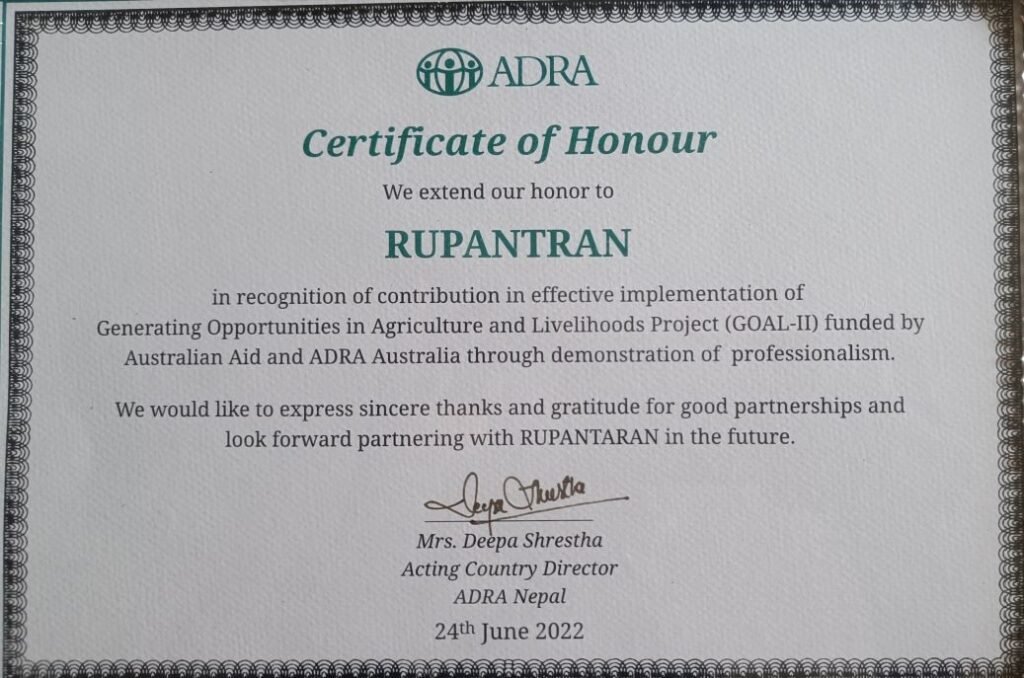
The Generating Opportunities in Agriculture and Livelihoods (GOAL-II) Project was a specialized climate resilience and economic empowerment framework designed to upgrade livelihoods and institutionalize sustainable resource practices in Nepal. Funded by Australian Aid and ADRA Australia, and coordinated through ADRA Nepal, Rupantaran served as a key implementation partner driving enterprise creation, gender equity, and localized governance planning. Operating dynamically within Swargadwari Municipality (Pyuthan) and Runtigadhi Rural Municipality (Rolpa), Rupantaran built robust community institutions, delivered advanced socio-economic empowerment interventions, and mainstreamed inclusive climate-smart blueprints directly into local government systems.
- Enterprise Development and Rural Financial Access
Rupantaran launched systematic micro-financial integration and localized capacity building to transform vulnerable subsistence growers into autonomous micro-entrepreneurs. By strengthening saving and credit practices and facilitating targeted low-interest capital injections, the intervention created sustainable investment paths for marginalized smallholders to adopt innovative market technologies, expand their production scale, and secure independent community wealth loops.
Impactful Achievements and Outcomes
- Strengthened grass-root group saving and credit mechanisms, driving financial self-reliance among target households.
- Facilitated direct micro-loan access for more than 2,500 group members to accelerate enterprise launch and expansion.
- Identified a comprehensive baseline of 1,312 distinct community improvement actions right at the project’s inception phase.
- Successfully materialized more than 700 targeted local actions purely driven by community efforts and stakeholder coordination.
- Commercial Agriculture Expansion and Small-Scale Irrigation Systems
To conunteract structural food insecurity and climate-induced water shortages, Rupantaran drove technial modernization across selected agriculturual value chains, focusing intensely on high-yield vegetable production and resilient goat raising. The strategy combined intensive, field-based Training-of-Trainers (ToT) models for progressive lead farmers with the physical installation of climate-smart micro-irrigation lines to maintain year-round soil productivity.
Impactful Achievements and Outcomes
- Certified 120 progressive lead farmers through intensive 5-day technical Training of Trainers (ToT) events focused on innovative agriculture.
- Completed the construction and commissioning of 12 small-scale community irrigation schemes to guarantee year-round farm watering.
- Developed 42 premium vegetable demonstration sites to host decentralized peer learning and showcase climate-smart tools.
- Equipped 735 active group members with specialized, context-appropriate climate change adaptation technologies.
- Constructed 16 permanent dipping tanks at targeted goat pocket sites to eliminate external parasite vulnerabilities and secure livestock assets.
- Social Accountability, Local Planning Alignment, and GESI Integration
Rooted in human rights and institutional sustainability, Rupantaran aligned local municipal governance workflows with standardized Gender Equality and Social Inclusion (GESI) policies. The organization established rapid-response social protection networks, empowered women activists to counter structural gender-based violence (GBV), and assisted local administrative bodies to formalize multi-year sub-sector development plans to safeguard marginalized populations and persons with disabilities (PWD).
Impactful Achievements and Outcomes
- Mobilized 36 highly active women activists working in close coordination with local governments and police departments to handle community violence cases.
- Established active, ward-level Gender-Based Violence (GBV) control networks linked directly to municipal judicial committees.
- Formulated a comprehensive GESI awareness curriculum tailored explicitly for higher secondary educational institutions.
- Successfully rolled out the specialized GESI curriculum across 18 secondary schools to institutionalize youth equity awareness.
- Technically supported local governments to formulate formal, multi-year sub-sectoral development plans for vegetable and goat farming.
- Assisted municipal partners in creating long-term operations and maintenance procedures and disaster profiles to protect public infrastructure.
Strategic Relevance and Institutional Value
Through its successful execution of the GOAL-II project, Rupantaran verified its institutional capability to manage specialized, highly integrated resilience portfolios under strict international funding parameters. The organization demonstrated mastery in translating complex systemic frameworks—spanning financial access, hard environmental engineering, rights-based social protection networks, and localized public policy—into concrete, quantifiable grassroots achievements. By bridging local government administrative offices with highly vulnerable populations across Rolpa and Pyuthan, Rupantaran has built a scalable model for sub-national governance. The organization stands as an elite national partner ready to anchor prospective international portfolios in inclusive economic growth, localized climate change adaptation, and rights-driven community resilience programming.

0 Comments